
I have an Oura smart ring, which is a health tracker. It monitors my activity and measure such things as heart rate, body temperature and more. It also tells me how I have slept overnight by giving a score out of 100. Last night, I got a score of 92 with a gold crown on top, which tells me I got a great night of restorative sleep. The score is based on the number of hours asleep, how long it takes to fall asleep, amount of deep sleep, REM sleep and more. I have faith in what my ring tells me about my health.
Most times, my score aligns with how I feel. Low score, I feel tired and sluggish. High score and I’m ready to tackle the day with energy. Other times, how I feel and the score I receive do not tally. I get a score in the high 80s and think, “that can’t be right,” because the last thing I want to do is get out of bed. But, I know that I have to trust the data and the numbers. They are more accurate than how I feel. In a way, the data gives me a foundation to start my day when my mind and body tell me otherwise.
Sometimes, having faith in God is like that. We feel like God is not there for us but we have to trust the data.
Maybe you’re been praying for a long time for God to show up in a situation but your prayers are not being answered. It’s like they are just floating into deep space. Or when circumstances are bleak, God’s presence can seem far away.
Our feelings of neglect, emptiness, and despair are real. But, they don’t always tell the full truth.
Just as I rely on my Oura ring to measure sleep more accurately than I can, we need to rely on God’s Word to tell us what is true when our hearts and minds say otherwise.
I think that’s what the writer of Lamentations 3 felt like. It seemed like God had abandoned him.
The writer looked out over Jerusalem after it had been destroyed. He saw ruins, grief, and despair everywhere. He poured out what he felt honestly to God—feelings of abandonment and affliction.
His complaint begins:
I am the man who has seen affliction
by the rod of the Lord’s wrath.
He has driven me away and made me walk
in darkness rather than light;
indeed, he has turned his hand against me
again and again, all day long.
His complaint continues for many verses. You can read about the neglect he felt in Lamentations 3:1-20.
But then there is a shift. It is like he has looked at the data, the evidence:
“Yet this I call to mind…” he says.
Because of the Lord’s great love we are not consumed,
for his compassions never fail.
They are new every morning;
great is your faithfulness.
I say to myself, “The Lord is my portion;
therefore I will wait for him.”
What a remarkable shift. In one moment he is consumed by despair, and in the next he speaks to his own soul about God’s love, God’s compassion, God’s faithfulness—the true data. His feelings say one thing, but God’s promises say another. He chose to hold onto what he knew was true.
We have to wake up in the morning and trust the data—God’s faithfulness is new every morning.
Maybe tomorrow morning, before you scroll your phone or pour coffee, you could whisper these words: “Your mercies are new today, Lord. Great is your faithfulness.” That simple prayer is how we reset our weary hearts and remind ourselves of what is true.
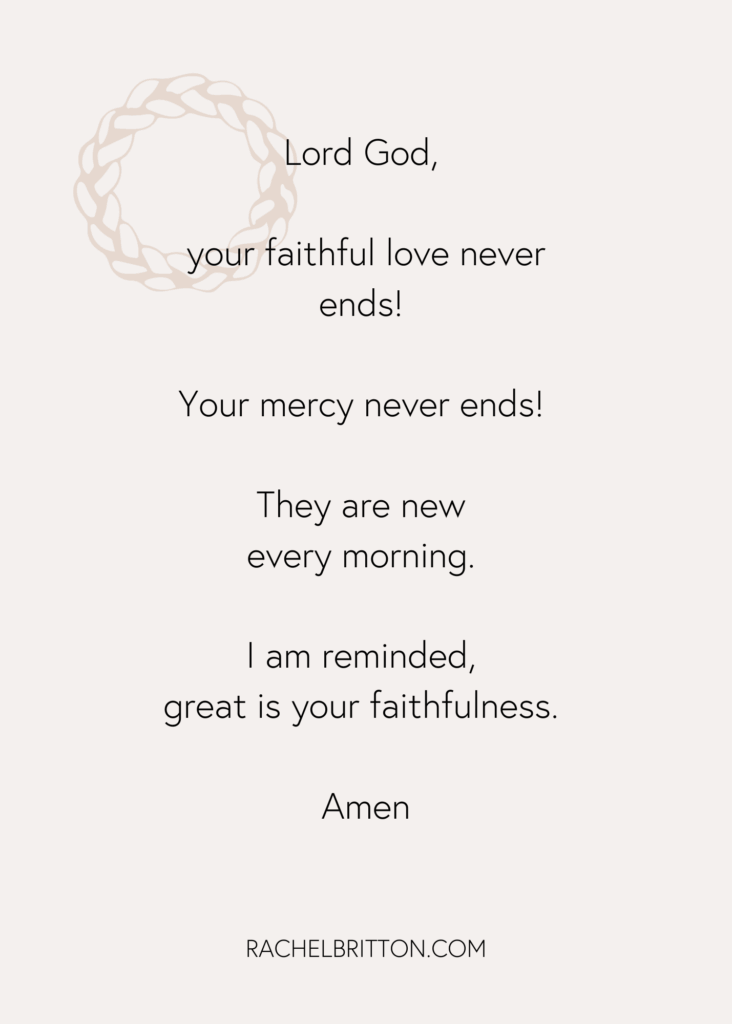
Take the prayer below, print it out, and say it each morning for this month. Then see how your weary heart and mind has been strengthened.
Pray